



























Trying to write a resume when you have a career gap, limited experience, or a non-traditional background for a specific role can feel overwhelming.
Even though you know you have the skills for it, you might feel insecure turning that into a chronological resume.
And just when you're losing hope, you learn about functional resumes.
“Ha! A resume that focuses on skills and not experience? Perfect!”
Not so fast.
On paper, a functional resume sounds perfect because it focuses on your know-how rather than on traditional work experience.
But here’s the truth: recruiters don’t really like functional resumes.
The good news is, there's a way you can effectively pack all your skills and experiences into a traditional resume in a way that grabs recruiters' attention (even if you don't have the traditional experience).
In this guide, we'll break down what a functional resume is, why it falls flat with recruiters, and what you should do instead to create a job-winning resume.
The sections of this article include:
- What Is A Functional Resume?
- Why Recruiters Don't Like Functional Resumes
- How To Write A Job-Winning Resume (Even If You Don't Have The Traditional Experience)
Let's get started!
What Is A Functional Resume?
A functional resume is a type of resume format that highlights your skills and abilities rather than focusing on your chronological work history.
Instead of listing jobs and dates at the top, it organizes your experience into skill-based sections like “Project Management,” “Marketing Skills,” or “Technical Skills.”
What Is The Difference Between A Functional Resume And A Traditional Resume?
The biggest difference comes down to structure:
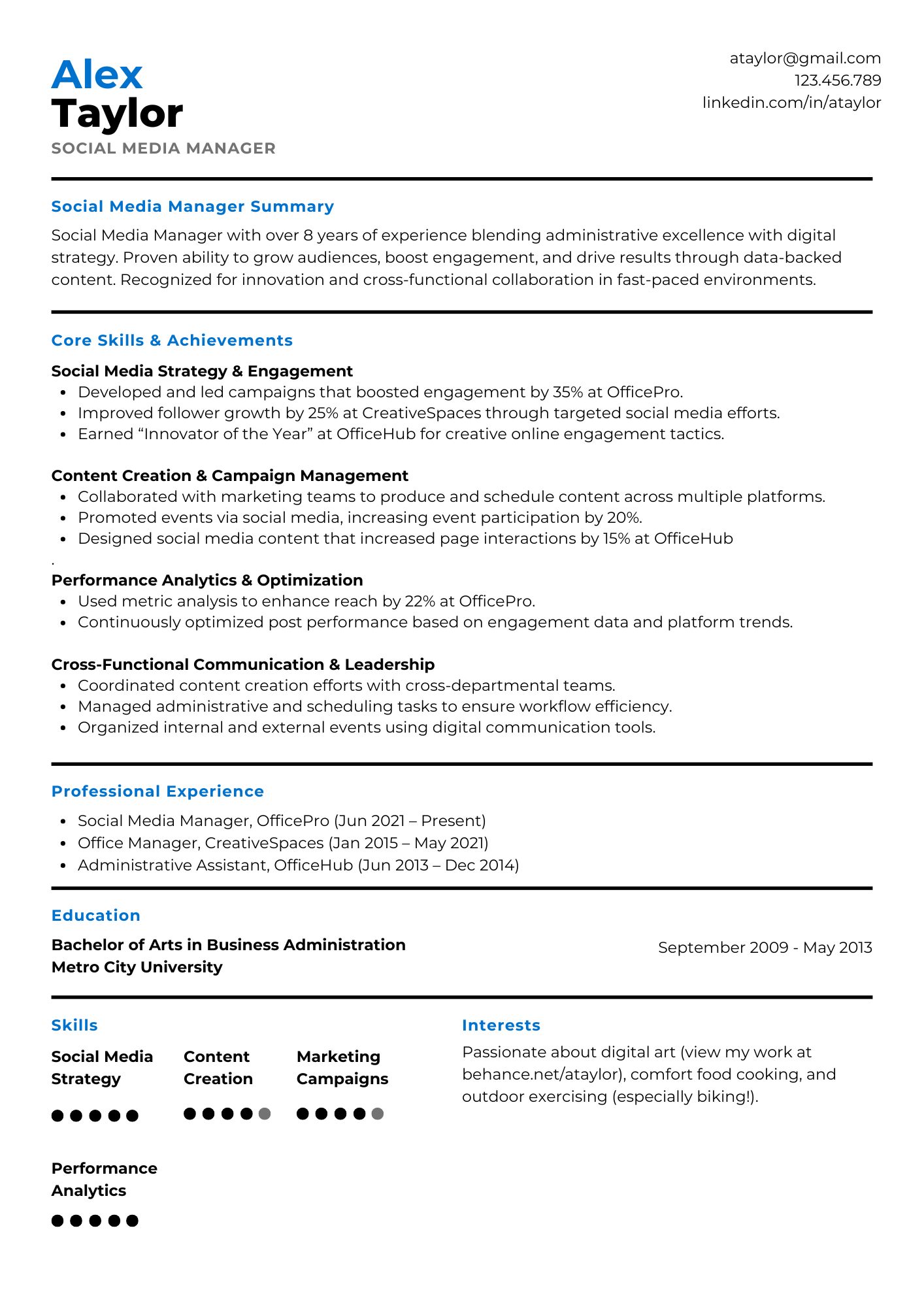
A functional resume focuses on skills and abilities. Work history is often de-emphasized or pushed to the bottom without details like dates or job descriptions.
Here's an example of what a functional resume for a Social Media Manager with a non-traditional background might look like:
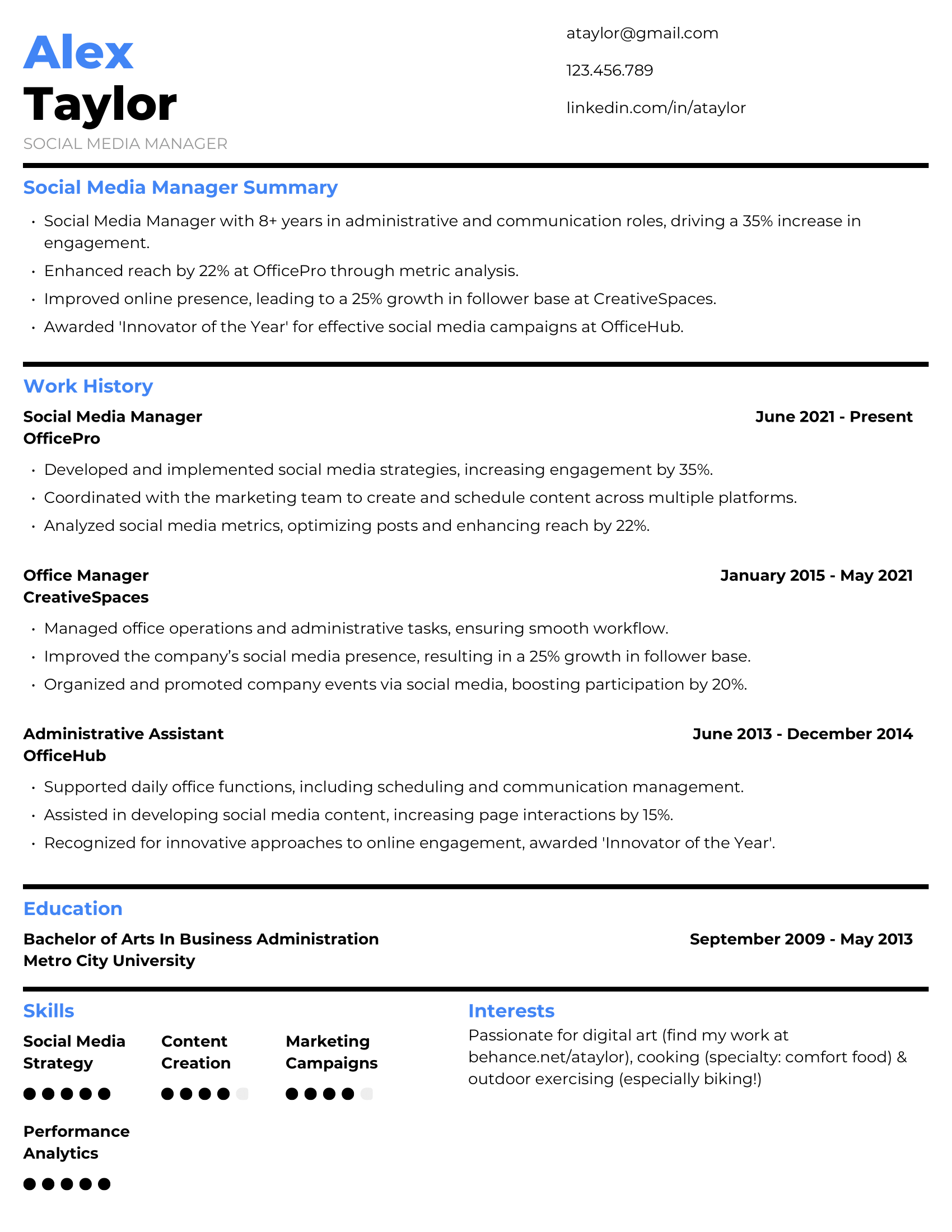
A traditional resume lists work experience in reverse chronological order with job titles, companies, dates, and bullet points describing accomplishments.
Here's an example of what that same Social Media Manager resume would look like in a traditional format:
Why Might You Choose To Create A Functional Resume?
Job seekers typically consider a functional resume if they:
- Have significant career gaps
- Are changing industries or careers
- Have limited traditional work experience (like recent grads or career changers)
- Want to shift focus from job titles to transferable skills
At first glance, it makes sense. You want to highlight your strengths and avoid drawing attention to anything that feels like a weakness on your resume.
But the question is:
Do Recruiters Like Functional Resumes?
Recruiters and hiring managers generally dislike functional resumes.
Don't just take our word for it: these Reddit and Quora users all recommend going with a traditional resume.
One user on Reddit even said:
As someone who used to screen resumes as admin….functional resumes are the worst.
Recruiters wanted to know what you did at each role, and when.
I might suggest having a critical skills section at the top with a few key related skills, and a section under your employment with the courses and such you've done.
A long break in employment is not necessarily a deal breaker, but perhaps try and reference it in a cover letter.
Here's why recruiters don't usually enjoy a functional resume:
1. It Feels Like You’re Hiding Something
When recruiters see a resume without job titles, dates, or clear timelines, red flags go up. It immediately creates questions:
- “What is this person trying to hide?”
- “Are there major career gaps?”
- “Is this experience recent or from 10 years ago?”
Most recruiters will move on rather than try to fill in the blanks.
2. Hiring Managers Want Context
Listing a skill like “Managed budgets” is meaningless without context.
Was it a $500 budget, or a $500,000 budget?
Was it at a nonprofit or a Fortune 500 company?
Without job context, recruiters can’t assess the scale, relevance, or recency of your experience.
3. It Can Feel Dishonest (Even If It’s Not)
Functional resumes aren’t dishonest, but they can give the impression that you’re trying to obscure your real work history. That mistrust alone can get your application tossed aside.
Plus: Functional Resumes Break Down ATS (Applicant Tracking System) Work
ATS systems are designed to parse resumes that follow a typical chronological format. Functional resumes often confuse these systems because they don’t provide clean job titles, dates, and experience.
That means your functional resume template could end up unread or misinterpreted by the ATS, blocking you from ever being seen by a human recruiter.
How To Write A Job-Winning Resume (Even If You Don’t Have Traditional Experience)
Here’s the good news: You don’t need a functional resume to tell a powerful career story — even with a career gap, a non-linear path, or limited experience.
Instead, you can tailor your resume in a way that still highlights your skills and knowledge, rather than in traditional experience.
Here’s how:
Step 1: Start With A Powerful Header
Sounds pretty basic, right? But there are a few nuances you don't want to overlook if you want to be considered for the role.
In addition to your full name, phone number, and email, you also want to add:
- Your target job title: Yup, even if you are aiming for a Marketing Manager role without ever having any experience as a Marketing Manager. This will help with ATS scans.
- Your (customized) LinkedIn URL: Adding your LinkedIn profile to your resume is a great way to let recruiters learn more about you. Just don't forget to customize your LinkedIn URL so it's easy to access! Here's a guide on how to update it.
Here's an example of what a powerful resume header looks like:
Jordan Smith | Data Analyst
[email protected] | (123) 456-7890 | linkedin.com/in/jordansmith
Step 2: Write A Targeted Resume Summary
Your resume summary is the very first thing employers read in your resume, meaning this section should be spot-on if you want to increase your chances of landing the role!
But here's the thing: most candidates write resume summaries that don't illustrate any real value to the hiring team.
If you want to grab recruiters' attention, you'll want to try featuring your summary as a “Highlight Reel”, where you will pick and choose the best and most relevant experience.
The Highlight Reel resume summary consists of 4 parts:
- A relevant section title that ties your experience to the role (For example, “Marketing Manager Summary”)
- An introductory bullet that summarizes your experience and high-level value
- A few supporting “Case Study” bullets that illustrate specific results, projects, and relevant experience
- A closing “Extracurricular” bullet to round out your candidacy
Here's an example:
Marketing Manager Summary
– Marketing Manager with 5+ years of experience driving audience engagement, content growth, and lead generation through data-backed strategies and storytelling
– Led a content marketing initiative for a bootstrapped startup, increasing blog traffic from 2K to 20K monthly visits in under 12 months using SEO strategies
– Built and launched a customer email onboarding series that improved product activation by 32% and reduced churn by 18%
– Host of a podcast exploring brand storytelling strategies from indie creators and marketers.
Now you have a resume summary that showcases your results, not just your experience!
Step 3: Add A Skills Section
Traditional resumes also showcase skills. We recommend adding 6–10 hard and/or soft skills that are relevant to the job description.
Here's how to know what skills you should include:
- Go to ResyMatch.io
- Select “Job Description Scanner” in “Scan Type”
- Paste your job description in the box
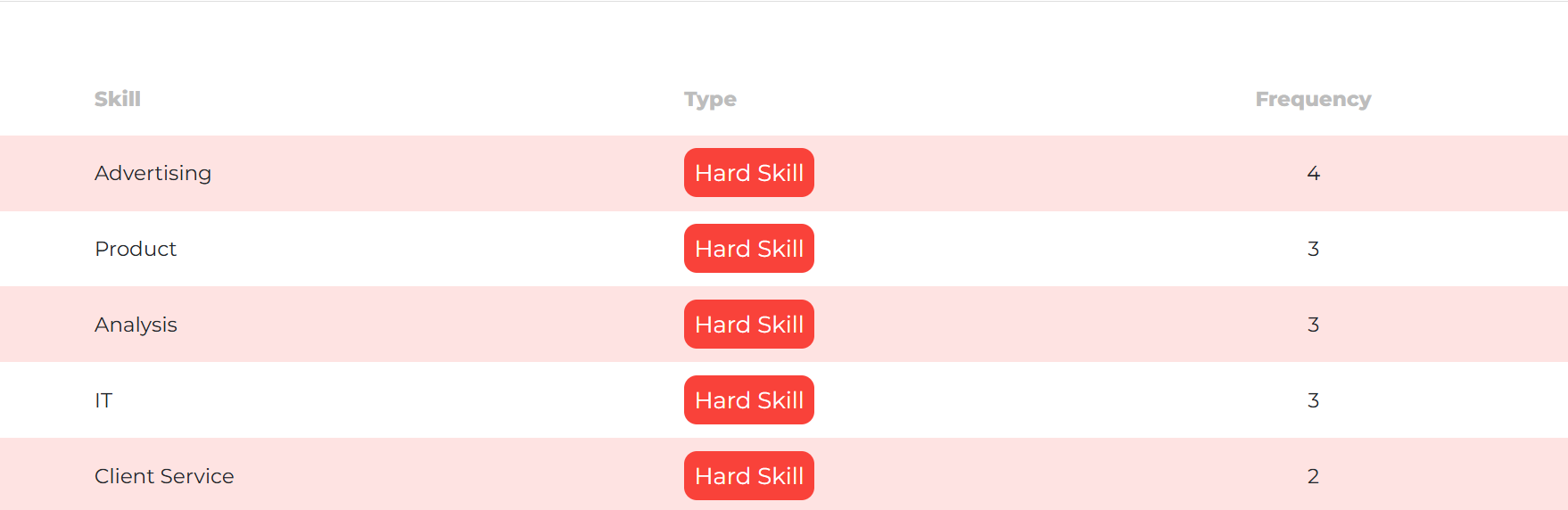
ResyMatch will show you the skills required for the role and the frequency with which they appear in the job description. Use that information to tailor your resume for the role!
Use the shortcut below to get started for free:
Scanning...

Step 4: Focus On A Results-Driven Experience Section
This might be the most challenging part of writing a resume: referencing your work experience.
When listing your professional experience, you'll want to include:
- The job title
- The company name
- The dates of employment
- 3–5 bullet points
Here's the thing, though: most candidates will only state what they did.
For example: “Responsible for marketing campaigns”.
The problem? This resume bullet says nothing about your experience and the results you can drive.
The good news is there's a formula you can use to really grab recruiters' attention when referencing your work experience.
You want your resume bullet to focus on measurable results, hard and soft skills, and contain the right amount of action words and common words.
And ResyBullet.io helps you with just that!
ResyBullet scans and scores your resume bullet and shows you how you can improve it.
For example, this is what “Responsible for marketing campaigns” scored:
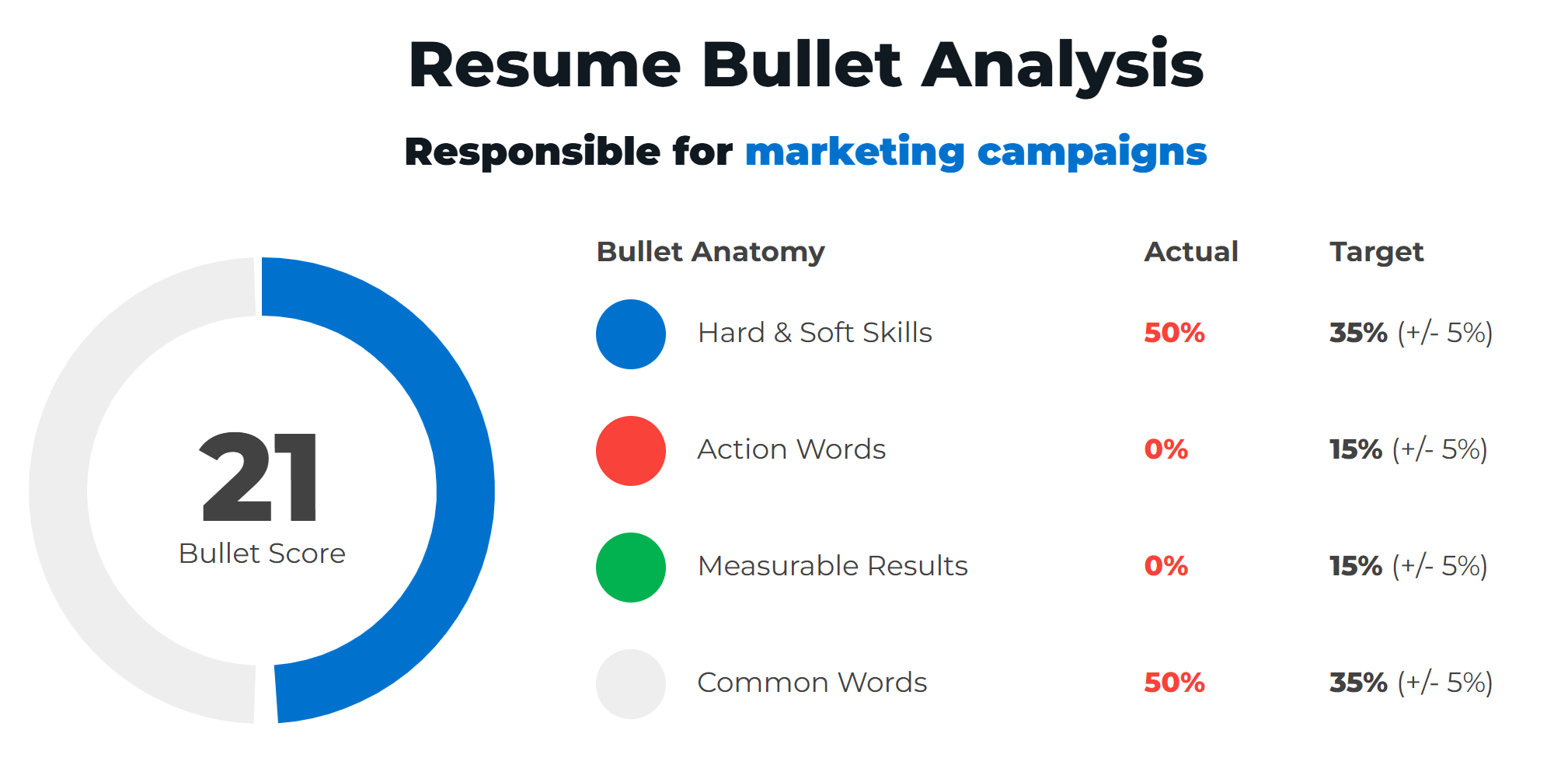
Now, let's aim to improve this resume bullet using measurable results, hard and soft skills, and action words.
Let's try:
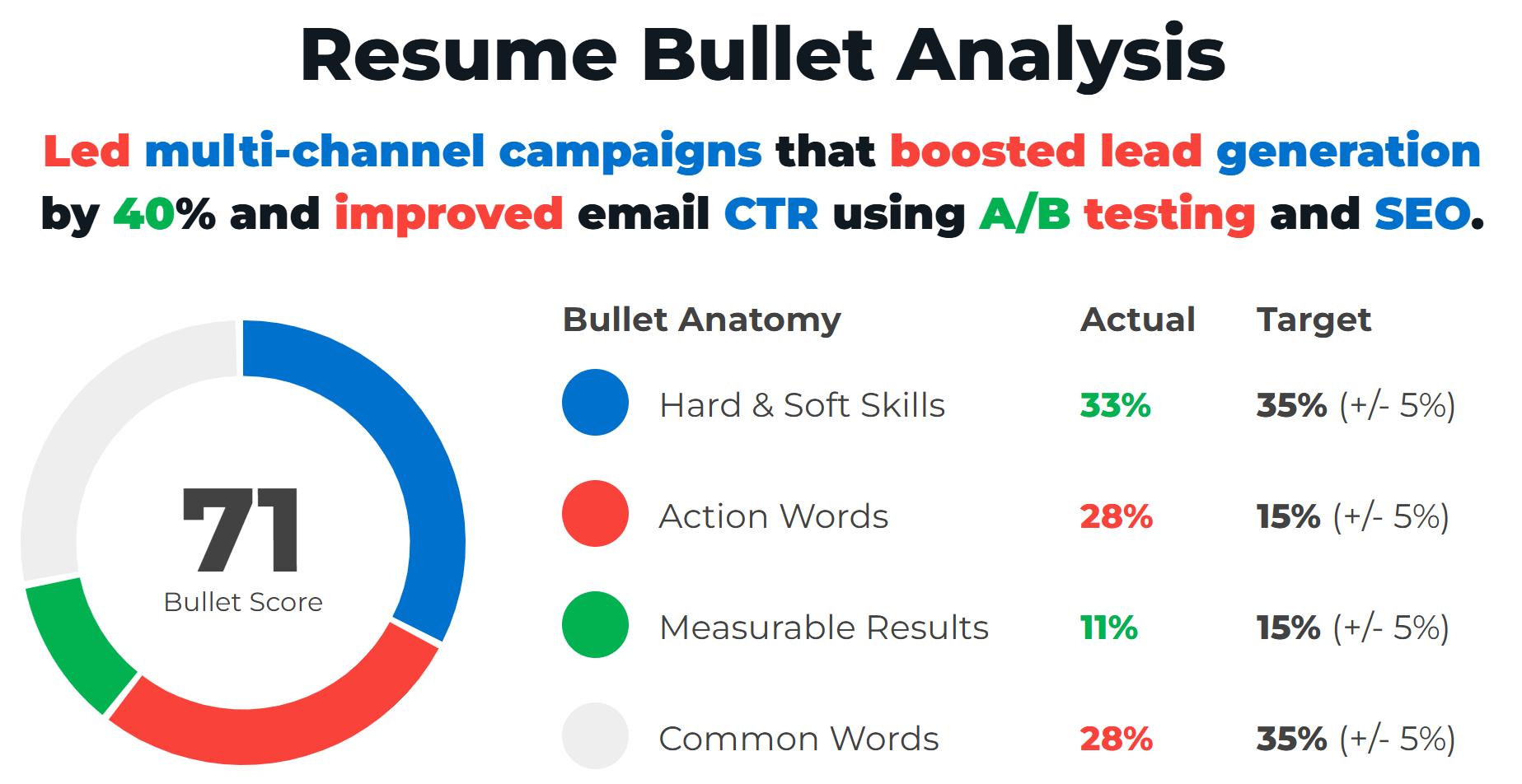
“Led multi-channel campaigns that boosted lead generation by 40% and improved email CTR using A/B testing and SEO.”
Here's what changed:
✅ Action Verb: Replaced “Responsible for” with “Let” to show initiative and leadership
✅ Specificity: Clarified that the campaigns were multichannel
✅ Measurable Results: Included concrete impact (“boosted lead generation by 40%” and “improved email CTR”)
✅ Hard Skills: Mentioned “A/B testing” and “SEO”
✅ Conciseness: Kept the bullet under 20 words and 120 characters, making it skimmable and ATS-friendly.
And this is our new score:
Want to learn more? This video walks you through a step-by-step guide to writing a job-winning resume bullet:
Step 5: Add Education & Certifications
Now it's time to add your completed or ongoing education and certifications.
Here's what you can add to this section:
- Completed degrees
- Ongoing education
- Certifications
- Relevant coursework or training
The best format includes the degree/certification, institution, and dates.
For example:
High School Diploma | Miami High | September 2006 – May 2010
B.A. In Communications | University of Miami | September 2010 – May 2014
Content Marketing and SEO Certificate | Semrush Academy | June 2018
Applied AI Bootcamp | 4Geeks Academy | October 2024
Step 6: Add An Interest Section
Adding an interest section to your resume is optional, but it's a great way to let recruiters learn more about yourself. It can also work as a conversation initiator!
Here's how you can make your resume's interest section interesting:
✅ Choose interests that are quirky, specific, and emotionally resonant. For example: “Stumptown coffee” instead of just “Coffee”.
✅ Focus on the five categories that people connect with emotionally: Food & Drink, Sports, College, Hobbies, Geography & Travel
✅ Enrich interest with specific details such as favorite brands, authors, locations, or anecdotes.
Here's an example:
Obsessed with single-origin espresso (especially from Stumptown), passionate for behavioral science books (like “Thinking in Bets” by Annie Duke) & hot sauce collector with a soft spot for Cholula and anything ghost pepper-infused.
Use ResyBuild.io For Job-Winning, ATS-Friendly Resumes
Now that we've covered how to write a resume even when you don`t have the traditional experience for the role, it's time to pack all that into a neatly designed, ATS-friendly resume template.
The best way to do this is by using tools like ResyBuild.io, which help you create a clean, ATS-optimized resume with templates designed to showcase your value without relying on a functional resume format.
ResyBuild.io is a free AI resume builder that helps you easily build and customize your resume in no time.
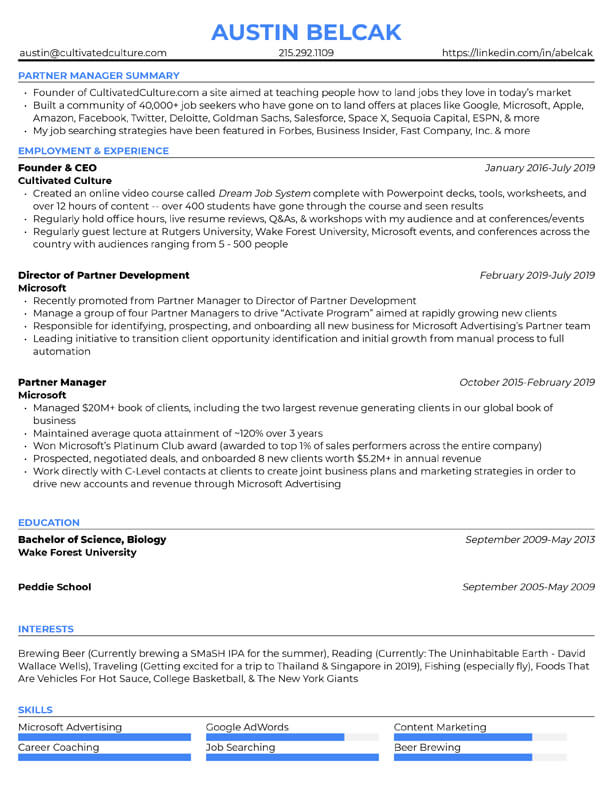
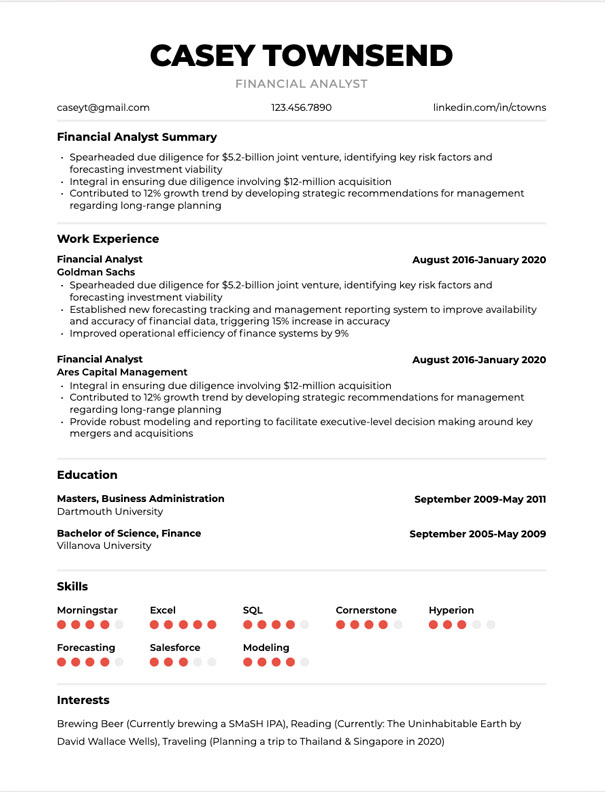
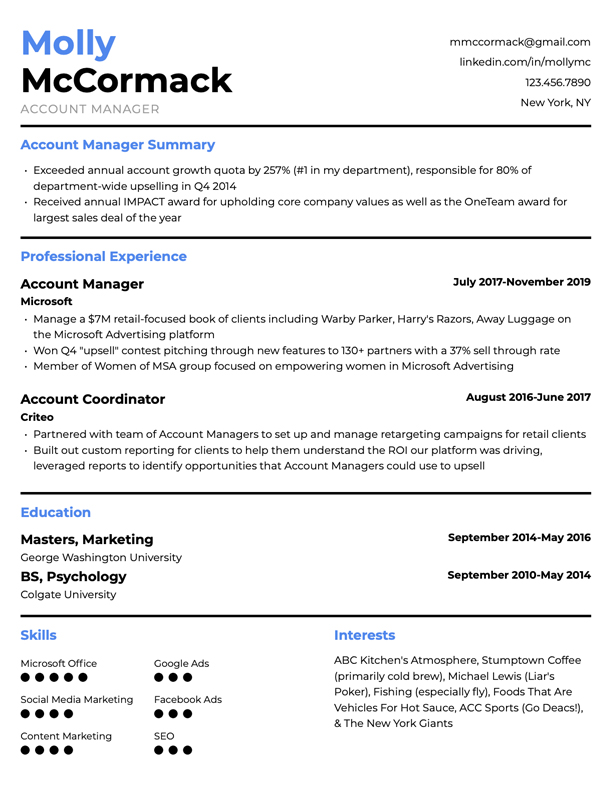
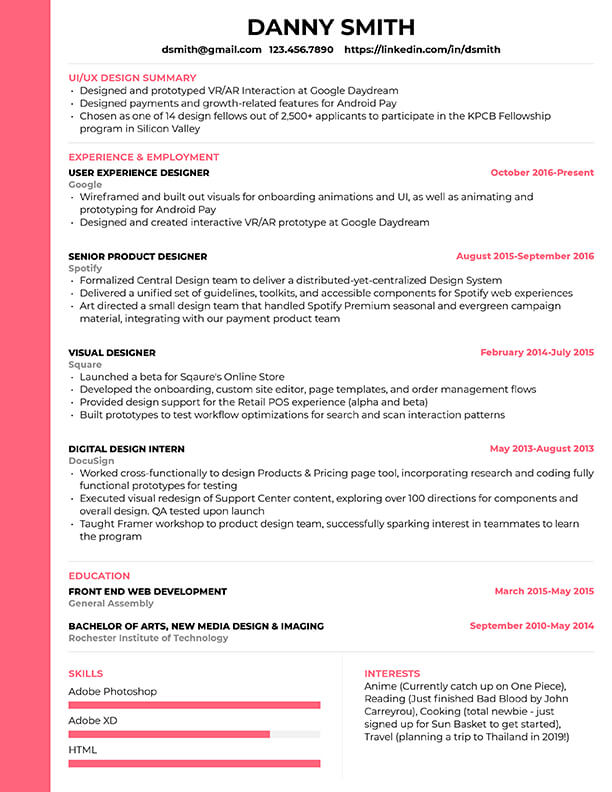
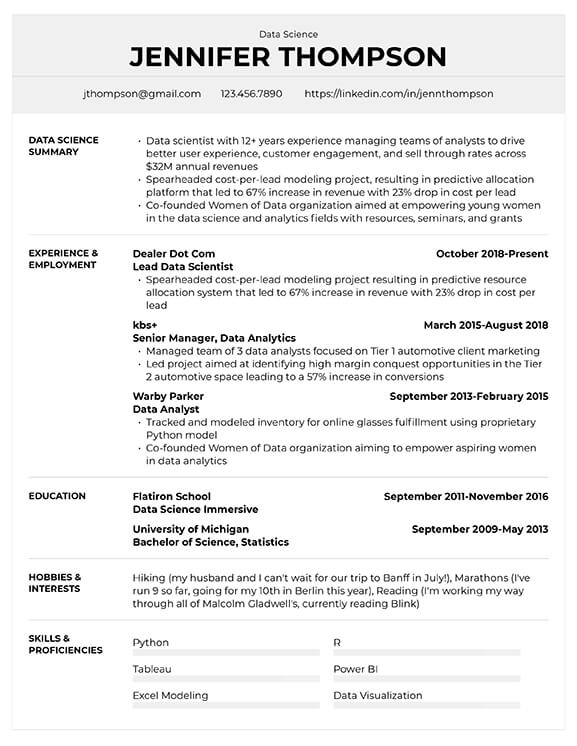
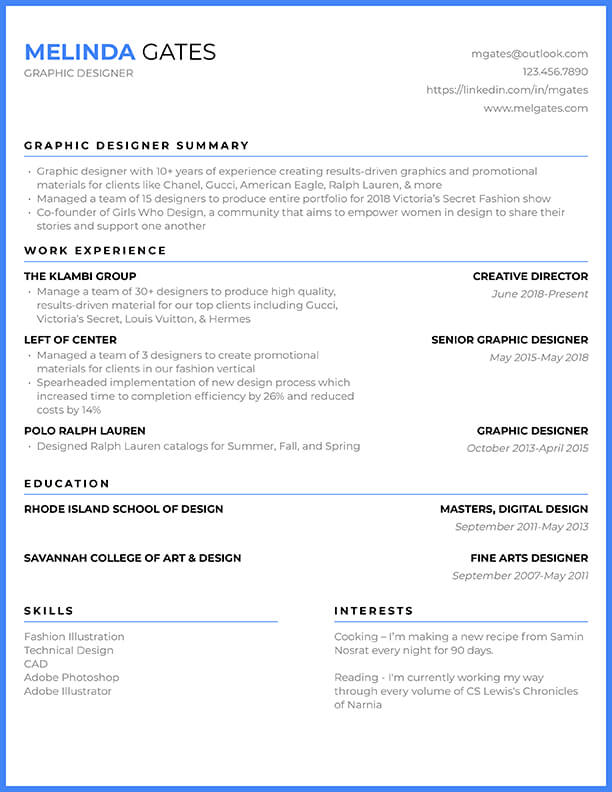
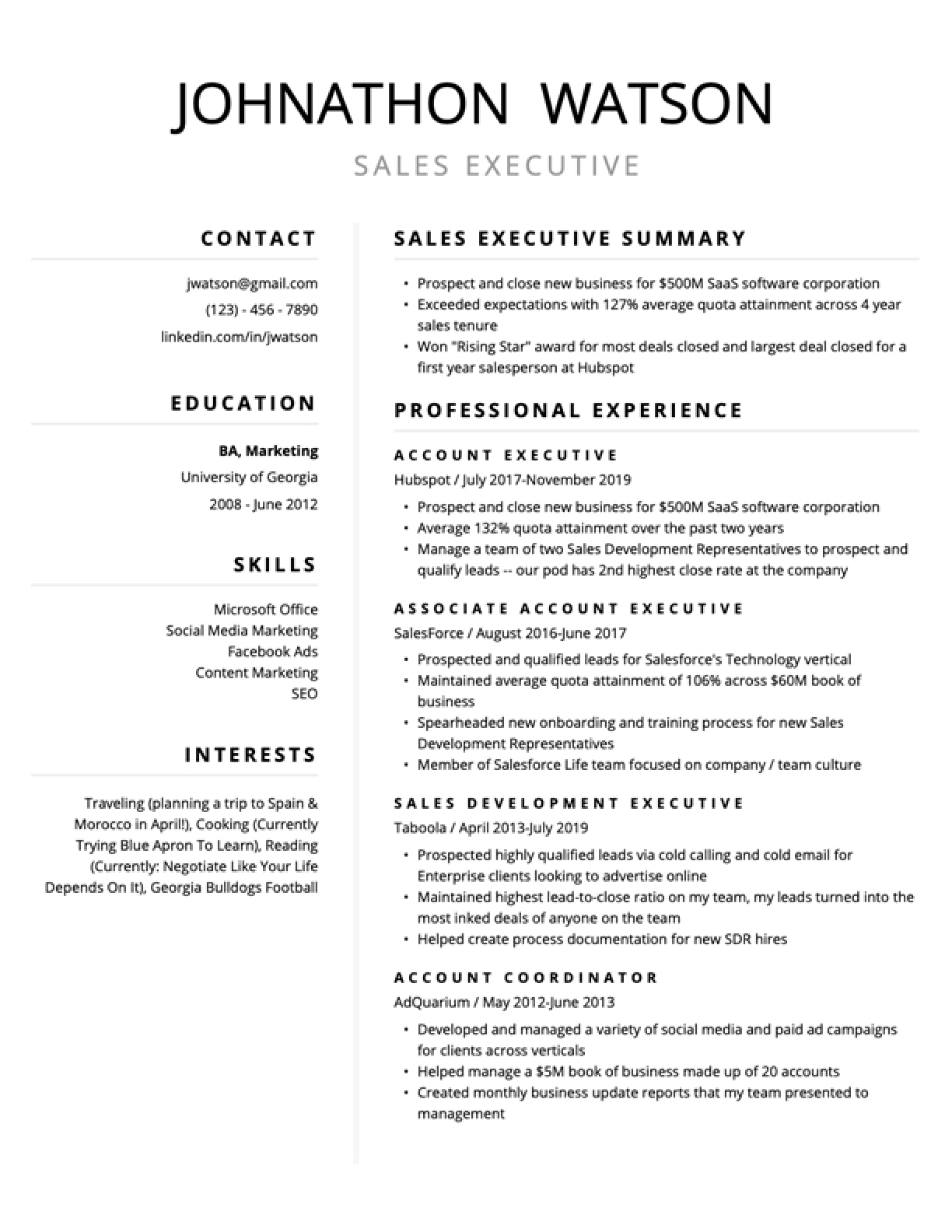
Choose from 8 proven templates and easily create, edit, and customize your resume. ResyBuild's AI assistant also helps you craft personalized, job-winning bullets in a single click. Simply add your experience, hit “Optimize”, and watch the magic happen.
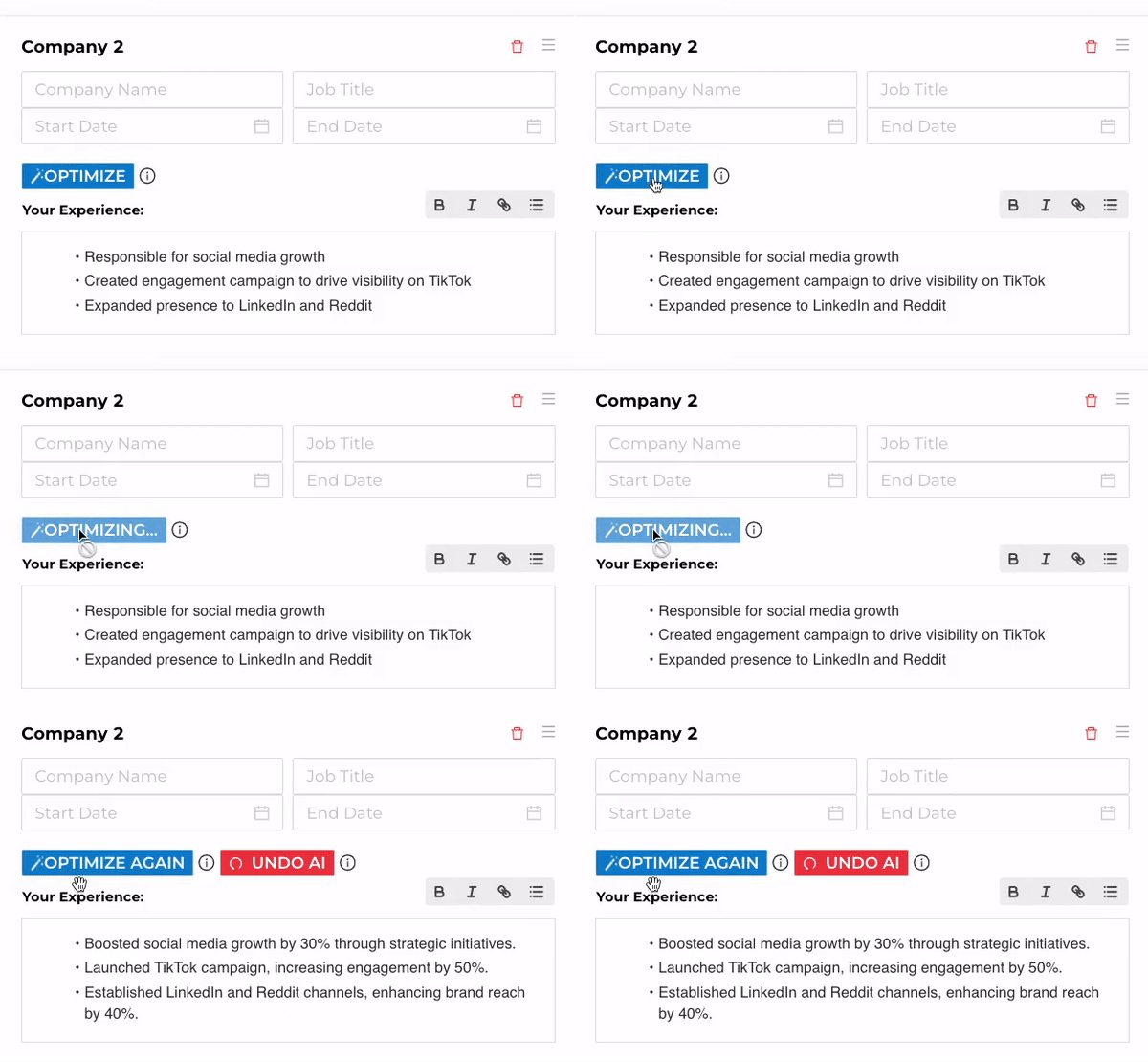
ResyBuild is also ATS-friendly, meaning it will help you write and design your resume in a way that doesn't get filtered out by ATS checkers, a software recruiters use to manage applications.
Final Thoughts
Here’s the bottom line: While a functional resume might seem like an easy fix for career gaps or non-traditional paths, it’s rarely the best option. Not only aren't they recruiters' favorites, but also, ATS struggles to read them, and they strip away the valuable context that hiring managers need.
Instead, use a traditional resume that highlights your skills and your experience, framing your story in a way that’s honest, clear, and tailored to the job you want.
If you want a head start, try ResyBuild.io for free! Just pick a template below to get started:

Free Job-Winning Resume Templates, Build Yours In No Time.
Choose a resume template below to get started: