































AI has changed work more in the last 2 years than anything else the last 20.
I want to help you stay ahead of the curve, so I'm starting something new. Every month, I'm doing a deep dive on the biggest ways AI is impacting work as we know it. Then I'm distilling it down into a single “report” that I'll email your way every month.
I spent the last week digging through reports from BCG, LinkedIn, the World Economic Forum, Gensler, and more to build the first edition for April 2026.
Here are 8 AI stats that should change your career plan:
Insight #1: 55% of Jobs Will Change in 3 Years
BCG just analyzed 165 million jobs across 1,500 roles. Their conclusion?
Over half of US jobs will be reshaped by AI in the next two to three years.
Not eliminated. Reshaped.
The tasks inside your role will look different, even if the title on your LinkedIn stays the same:
BCG also found that companies who cut their workforce beyond what AI can actually replace saw productivity drop and critical talent walk away. The smart companies are reassigning roles, not eliminating them.
Your Move: List five things you do every day and look up which ones AI can already handle. That tells you where to focus your energy going forward.
Insight #2: AI Literacy Postings Up 70% Year-Over-Year
According to LinkedIn’s 2026 labor market data, job postings requiring AI literacy jumped 70% in just one year. And they’re not looking for engineers.
They want people who know how to use AI tools inside their current role. Think: marketing managers who can use AI for research, salespeople who can use it for prospecting, project managers who can automate status updates.
In fact, Microsoft found that 66% of leaders say they won't hire someone who doesn't have AI skills:
Your Move: Start small. Pick one tool used in your field and spend 30 minutes with it this week. That’s the starting line.
Insight #3: AI Skills Pay 56% More
Workers with AI skills now earn a 56% wage premium over similar roles without those skills.
That’s up from 25% a year ago, according to Ravio’s compensation data.
You don’t need to become a data scientist.
But learning to use AI in your current job might be the single highest-ROI move you can make right now.
Insight #4: Entry-Level Tech Hiring Down 67%
This one’s tough.
Fortune reported that entry-level tech job postings have dropped 67% since 2023. And Ravio data shows a 73% decrease in entry level hiring:
AI is handling the “grunt work” that used to be the training ground for new hires.
We've seen degree value on the decline, and I think this amplifies that even more.
Your Move: Build a portfolio project using AI tools. Show employers you can contribute on day one. That’s what gets you in the door now.
Insight #5: 80% of Applicants Now Use AI on Resumes
Estimates suggest up to 80% of applicants are using AI to write resumes and cover letters. And hiring managers can tell.
When every application sounds the same, none of them stand out.
My Advice: Use AI to get a first draft, then rewrite the top three bullets in your own voice with specific numbers and outcomes. Be the human in a sea of bots.
Insight #6: Only 26% of Candidates Trust AI Hiring
Three out of four job seekers don’t trust AI to evaluate them fairly.
And a Berkeley Haas study found 44% of AI hiring tools show gender bias. This is real.
Your best defense? Specificity.
Vague descriptions get filtered.
Concrete numbers, results, and context land with the human on the other side.
Insight #7: AI Power Users Spend MORE Time With Teams
This one surprised me! Gensler surveyed 16,400 workers across 16 countries and found that the heaviest AI users actually spend less time working alone and more time collaborating.
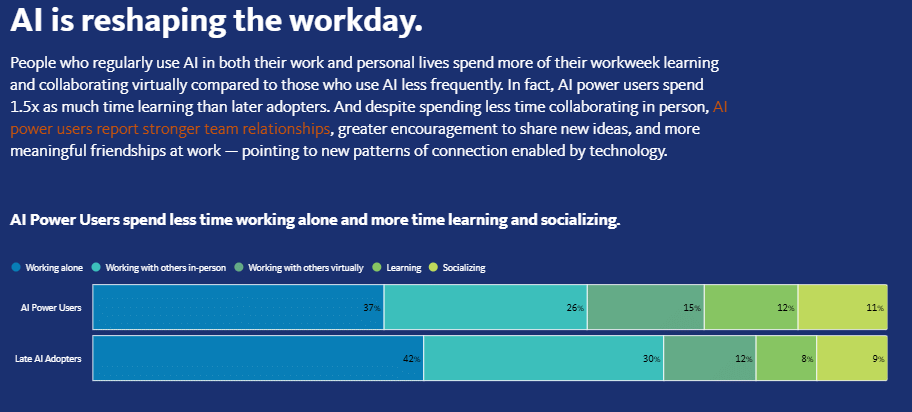
AI takes care of the busywork so people can spend time on the work that matters. Use AI to free up your calendar for the conversations and projects that actually get you noticed.
Insight #8: 80% Need New Skills, But Employers Aren’t Helping
The World Economic Forum says 80% of the global workforce needs new skills by 2027. But only 25% of employees say their employer has a clear plan for how to use AI.
More than half are figuring it out on their own.
Your Move: Don’t wait for your company to hand you a training program. Spend one hour this week on a free AI course through LinkedIn Learning or Coursera. Your future self will thank you.
Here’s the bottom line:
AI isn’t something that’s coming. It’s already here.
The people who win from this point forward are the ones who start learning now.
Not tomorrow. Not when their company rolls out a training program. Now.
You don’t need to become a technical expert.
You don’t need to learn to code.
You just need to start using these tools in your actual work and build from there.
Try to carve out 30 minutes this week to start on one thing I mentioned above.
That alone will put you ahead of 90% of the pack.
You’ve got this!