





























Whether it's getting budget approval, moving forward with a new project, closing a new deal, or landing a job offer, your presentation techniques have a direct impact on your outcomes.
The problem?
Most people approach presentations and interviews by listing information and simply hoping the audience connects the dots.
That rarely works.
High-performing professionals don’t just share information. They:
- Guide decisions
- Frame outcomes
- Validate value
In this guide, you’ll learn presentation techniques that actually work across any audience.
Let's start by clarifying:
Why Presentation Skills Matter More Than Ever

Presentations are no longer limited to conference rooms or keynote stages. They show up in stakeholder updates, client pitches, product demos, promotion panels, and interviews.
The thing is, most people associate presentation techniques with elegant, beautifully designed decks.
And while a polished design is definitely helpful, what really makes a difference is the way you tell the story and show up for questions.
Below are 8 presentation techniques you can use in multiple scenarios to help you reach your goal, with examples for different situations.
8 Presentation Techniques That Help You Hit The Right Target
Strong presentation skills signal leadership and solid decisions, leading you closer to your main goal, whether it's getting a new budget approved, closing a deal, moving forward with a new project, landing a promotion, or getting a job offer.
Here's a step-by-step to build a solid case:
1. Start With The Outcome, Not The Background
One of the most common mistakes people make in presentations and interviews is starting with the background.
They talk about their background, explain the company, the team, the situation… and by the time they get to the point, the audience has disengaged.
High-impact presenters do the opposite. They start with the outcome.
Before you speak, ask yourself the following questions:
- What decision do I want this audience to make?
- How does this decision benefit the audience?
- How can I prove that I can deliver a positive outcome with this decision?
Let's say you're presenting your case study for a recruiter. Here's how you could open your presentation:
“If I joined the team, my focus would be increasing product adoption by reducing friction in onboarding. I’d analyze usage data to identify drop-off points, pair that with customer interviews, and ship targeted improvements to the highest-impact steps. In my last role, this approach increased feature adoption by 25% and reduced onboarding-related support tickets.”
In this example, the decision you want is for them to hire you. The benefit they get is increasing product adoption. And you prove you can do this by presenting an action plan that has worked in your previous role.
Then, you can dive deeper into your action plan.
💡Pro Tip For Job Seekers: Lead With Value, Then Validate It
This is the core idea behind Value Validation Projects: you don’t say you can add value, you show exactly how you will.
In interviews, this looks like starting with the outcome, then presenting proof (metrics, a specific example, a mini plan for the new role).
2. Use the Problem > Insight > Solution Framework
Once you’ve anchored your message to an outcome, you need a structure that keeps your points clear and persuasive. One of the most effective frameworks is:
Problem > Insight > Solution
How It Works:
- Problem: What was broken, risky, or inefficient?
- Insight: What did you discover that changed the approach?
- Solution: What did you do (or what should be done next)?
Continuing the same interview case study example, here’s how you might explain your approach:
“When I looked at onboarding, the core issue wasn’t awareness, since users were signing up. The main issue was activation. Usage data showed a sharp drop after the first session. When I paired that with customer interviews, it became clear users didn’t understand which actions mattered most early on. To solve that, I simplified the onboarding flow and guided users toward one core action. That change increased feature adoption by 25% and reduced onboarding-related support tickets.”
- In this example, you:Clearly define the problem
- Show how you identified the real issue
- Explain the action you took
- Anchor everything to measurable results
This helps recruiters and hiring managers follow your thinking without having to piece it together themselves.
3. Focus On Proof, Not Responsibilities
After you explain your approach, most candidates fall into a trap: they start listing everything they did.
That’s not what interviewers are looking for.
They want to know what changed because of your work.
Here’s how you might continue the same presentation:
“My role wasn’t just improving onboarding screens — it was increasing adoption. I focused on the steps that directly influenced whether users reached value. By narrowing onboarding to the highest-impact actions and validating changes with real users, we saw adoption climb and support requests drop within the first month.”
Instead of saying:
- “I worked on onboarding.”
- “I collaborated with design”
- “I partnered with engineering”
You anchor your contribution to outcomes.
4. Use Short, Focused Stories With Metrics
At this point, interviewers often ask follow-up questions like:
- “Can you give me an example?”
- “What did that actually look like?”
- “How did you know it worked?”
This is where concise, metric-backed stories shine.
Here’s how you could answer without overexplaining:
“One example was our setup checklist. Users were dropping off before completing it. I reduced the number of steps, reordered them based on usage data, and added in-product guidance. Completion rates increased, which directly contributed to the 25% lift in adoption.”
Notice what’s missing:
- No long backstory
- No team organization chart
- No unnecessary detail
Just action > outcome.
5. Control The Pace To Reinforce Confidence
When presenting a case like this, rushing through results can undermine your credibility.
Here’s how you might slow things down intentionally:
“After we made the changes, we tracked adoption weekly. Within the first month… adoption increased by 25%.”
That pause before the result matters. It signals that the number is important and that you’re confident in it.
In interviews, pacing is often interpreted as seniority. Calm, deliberate delivery makes your experience feel more substantial.
6. Adapt The Depth Based On Who’s Listening
In many interview loops, you’ll present this same case to different audiences: recruiters, hiring managers, and panels.
The core story stays the same, but the depth changes.
Here’s how you might adapt without changing the narrative:
“At a high level, the goal was improving adoption by reducing onboarding friction. If you’d like, I can walk through the data we used to identify drop-off points or how we validated changes before rolling them out.”
This shows:
- You understand the big picture
- You can go deep if needed
- You’re reading the room
That flexibility is a strong signal for product roles, where communication across levels is critical.
7. Handle Questions By Reinforcing the Outcome
When interviewers ask questions, they’re often testing how well you understand the impact of your work.
Instead of getting defensive or overly detailed, tie your answer back to the outcome.
For example:
“That’s a good question. We considered a few different approaches, but we prioritized the one that reduced friction fastest. Our goal was adoption, and the data showed this path would get us there quicker.”
This keeps the conversation focused on results, not hypotheticals.
And if you can't answer a question?
Use this framework:
“That’s a great question. I don’t have the exact data, but I can dig into this. Here's what I can share for now.”
When you get back to them with a post-interview thank you email, follow up with the answer.
8. Close by Reconnecting To The Role
Finally, strong presenters don’t just end their case study. They connect it back to their goal.
Here’s how you might close the loop:
“The reason I’m excited about this role is because the challenge you described is very similar. If I joined the team, I’d take the same outcome-driven approach: starting with usage data, validating insights with users, and focusing on the actions that move adoption.”
This reminds the audience why the story matters and positions you as someone who can replicate success, not just talk about it.
Start Delivering High-Impact Presentations

Knowing the right presentation techniques is one thing. Applying them under pressure, like in high-stakes interviews, executive presentations, or promotion panels, is another.
That’s where our coaching program comes in.
Our coaching program, has helped thousands of professionals turn interviews and presentations into real outcomes, including:
- $44,000+ average raises
- Value-aligned job offers
- Offers secured in half the time of the average job seeker.
These results don’t come from rehearsing scripts or memorizing answers. They come from learning how to structure communication around outcomes, proof, and decision-making.
Make These Presentation Techniques Stick
In coaching sessions, professionals don’t practice hypothetical presentations.
They work directly on the real conversations that matter most: interview case studies, hiring manager presentations, promotion panels, and executive updates.
Coaches help clients:
- Lead with outcomes instead of background
- Frame their experience using clear problem-solution narratives
- Translate past work into measurable proof
- Answer follow-up questions with confidence and control
This is why clients often report a dramatic shift in how interviews feel less reactive, more intentional, and far more effective.
Coaching > Impact
Here’s what one client shared after implementing these strategies in his job search:
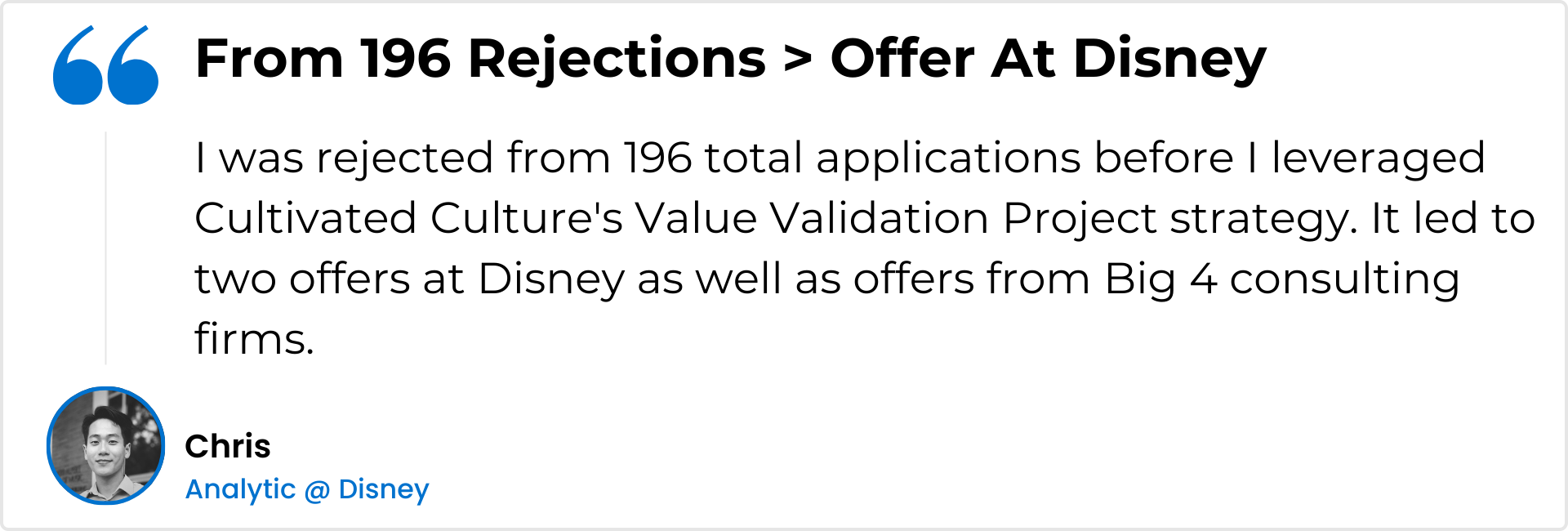
Stories like Chris’s are not unique. Other clients describe how coaching helped them refine how they tell their story, present their impact, and confidently connect their experience to the outcomes hiring managers care about.
When professionals learn to present their value with clarity, structure, and confidence, interviews become decision-oriented conversations, and offers soon follow.
Ready To Deliver Presentations That Actually Drive Decisions?
If you’re preparing for high-stakes interviews, case studies, or presentations where the outcome truly matters, Cultivated Culture’s coaching program is designed to help you show up with clarity, confidence, and proof.
You’ll work 1-on-1 with an expert coach to refine how you present your experience, structure your message around outcomes, and handle questions with confidence so your next presentation moves the decision in your favor.